NCERT SOLUTION
MOTION
0 questionsCBSE 2027
Share:
Study Notes

3. Which of the following is true for displacement?
(a) It cannot be zero.
(b) Its magnitude is greater than the distance travelled by the object.
Ans :-
(a) False; because the displacement is zero if an object returns to its initial position after completing the trip.
(b) False; the displacement always has equal or less magnitude than the distance travelled.
MOTION
VERY SHORT ANSWER TYPE QUESTIONS (VSAQ)
1. What is a reference point?
Ans :- A reference point is a fixed location used to describe the position of an object.
2. How do we know an object is in motion?
Ans :- An object is in motion when its position changes continuously compared to a fixed point.
3. Which speed is greater: 30 m/s or 30 km/h?
Ans :- 30 m/s
4. What do you mean by 2 m/s2?
Ans :- The velocity of the body increases by 2 m/s after every second.
5. What is circular motion?
Ans :- Circular motion is when an object moves in a circular path.
6. What is linear motion?
Ans :- Linear motion is when an object travels in a straight line.
7. What does oscillatory motion mean?
Ans :- Oscillatory motion is when an object moves back and forth around a central point.
8. What is the Si unit of acceleration?
Ans :- The SI unit of acceleration is m/s2.
9. What is the simplest type of motion?
Ans :- Motion along a straight line.
10. Name the two types of physical quantities.
Ans :- The two types of physical quantities are scalar quantity and vector quantity.
11. What is a reference point?
Ans :- A fixed location used to describe the position of an object.
12. In the example, where does the object start moving from?
Ans :- The object starts moving from point O.
13. What is the relationship between distance travelled and the time elapsed for the motion with uniform velocity?
Ans :- Distance is directly proportional to time used.
In fact, distance travelled = Uniform velocity × Time used.
14. What is the total distance covered by the object in the example?
Ans :- The total distance is 95 km.
15. What can you say about the motion of an object if its speed time graph is a straight line parallel to the time axis?
Ans :- Such a graph indicates that the object is travelling with uniform velocity.
16. What is the quantity which is measured by the area occupied below the velocity-time graph?
Ans :- The area under a velocity-time graph shows the distance or displacement an object has traveled.
17. What is distance?
Ans :- Distance is the total path length traveled by an object.
18. Is distance a scalar or vector quantity?
Ans :- Distance is a scalar quantity.
19. Can uniform linear motion be accelerated?
Ans :- No
20. Define one radian.
Ans :- It is the angle formed at the center of a circle by an arc whose length is the same as the radius of the circle.
21. What is the relation between linear velocity and angular velocity
Ans :- Linear velocity = Angular velocity x Radius of circular path.
22. Distinguish between speed and velocity.
Ans :- Speed of a body is the distance travelled by a body per unit time while velocity is the displacement travelled by a body per unit time.
23. What is displacement?
Ans :- Displacement is the shortest distance from the starting point to the ending point.
24. Can displacement be zero?
Ans :- Yes, displacement can be zero if the starting and ending points are the same.
25. What does the odometer of an automobile measure?
Ans :- The odometer in a vehicle is used to measure how much distance the vehicle has traveled.
26. Give the simplest type of motion.
Ans :- The simplest type of motion is the motion along a straight line.
27. Give two examples of a scalar quantity.
Ans :- Two examples of a scalar quantity are distance and speed.
28. What is magnitude?
Ans :- The numerical value of a physical quantity is called its magnitude.
29. What does the Graph of an object look like when it is in uniform motion?
Ans :- Graphically it will be linear; it looks like a straight line when it is in uniform motion.
30. What is uniform motion?
Ans :- Uniform motion is when an object covers the same distance in equal time intervals.
31. What is non-uniform motion?
Ans :- Non-uniform motion is when an object travels different distances in equal time intervals.
32. Define a scalar quantity.
Ans :- A physical quantity which has only magnitude and no direction is called a scalar quantity.
33. Define vector quantity.
Ans :- A physical quantity which has both magnitude and direction is called a vector quantity.
34. Give two examples of a vector quantity?
Ans :- Two examples of a vector quantity are displacement and velocity.
35. What unit is commonly used to measure speed?
Ans :- Speed is commonly measured in meters per second (m/s).
36. The phenomenon of motion was placed on a sound scientific footing by two scientists. Write their names.
Ans :- Galileo Galilei and Isaac Newton.
37. How do you calculate average speed?
Ans :- Average speed is calculated by dividing the total distance traveled by the total time taken.
38. Which type of graph is used to describe motion?
Ans :- Line graph are used to describe the motion of an object.
39. When is the acceleration of a body positive?
Ans :- The acceleration of a body is taken to be positive if it is in the direction of velocity.
40. Differentiate acceleration from velocity.
Ans :- Velocity is how fast an object changes its position in a certain direction over time, while acceleration is how fast the object's velocity changes over time.
41. If a car travels 100 km in 2 hours, what is its average speed?
Ans :- The average speed is 50 km/h.
42. What is acceleration?
Ans :- Acceleration is how quickly an object's velocity changes over time.
43. Are rest and motion absolute or relative terms?
Ans :- They are relative terms.
44. How do you calculate acceleration?
Ans :- Acceleration is calculated by dividing the change in velocity by the time taken.
45. What is the difference between positive and negative acceleration?
Ans :- Positive acceleration means the object speeds up, while negative acceleration (deceleration) means the object slows down.
46. Define the term velocity. What is its unit?
Ans :- Is it a scalar or vector quantity?
Ans :- Velocity is a physical quantity that gives the speed and direction of motion of the body
Velocity = Displacement / Time
The S.I. unit of velocity is ms–1. Velocity is a vector quantity because its description requires both magnitude and direction.
47. What is the acceleration of a body moving uniform velocity?
Ans :- The acceleration of a body moving with uniform velocity is zero.
48. Name the different types of graph.
Ans :- Bar graphs, straight line graphs, histograms, etc.
SHORT ANSWER TYPE QUESTIONS (SAQ)
1. What is the importance of a reference point in describing motion?
Ans :- A reference point is essential because it provides a fixed location to describe an object's position. By choosing a reference point, such as a railway station, we can measure how far and in what direction other objects are located. Without a reference point, it would be difficult to understand where something is in relation to something else.
Ans :- A reference point is essential because it provides a fixed location to describe an object's position. By choosing a reference point, such as a railway station, we can measure how far and in what direction other objects are located. Without a reference point, it would be difficult to understand where something is in relation to something else.
2. What is the difference between uniform velocity and non-uniform velocity?
Ans :- 1. Uniform velocity: Uniform velocity means an object moves the same distance in the same amount of time in a specific direction. For example, if an object is moving at a speed of 40 km/h towards the west, it has a uniform velocity.
2. Non-uniform velocity: When an object travels unequal distances in the same amount of time or its direction changes, it is said to have non-uniform or variable velocity. For example, a fan spinning at a constant speed still has a variable velocity because its direction keeps changing.
3. Can you explain the different types of motion?
Ans :- There are three main types of motion: circular motion, linear motion, and oscillatory motion. Circular motion occurs when an object moves in a circle, like a carousel. Linear motion happens when an object travels straight, such as a car on a highway. Oscillatory motion involves moving back and forth, like a swing. Each type has its unique path and characteristics.
Ans :- There are three main types of motion: circular motion, linear motion, and oscillatory motion. Circular motion occurs when an object moves in a circle, like a carousel. Linear motion happens when an object travels straight, such as a car on a highway. Oscillatory motion involves moving back and forth, like a swing. Each type has its unique path and characteristics.
4. What are the uses of a distance-time graph?
Ans :- The uses of a distance-time graph are as follows:
(a) It shows the position of an object at any moment in time.
(b) The graph helps us see how much distance the object covers in a certain period.
(c) It also provides information about the object’s speed at any point in time.
Ans :- The uses of a distance-time graph are as follows:
(a) It shows the position of an object at any moment in time.
(b) The graph helps us see how much distance the object covers in a certain period.
(c) It also provides information about the object’s speed at any point in time.
5. How do we recognize motion in our daily lives?
Ans :- We recognize motion by observing changes in the position of objects relative to reference points. For instance, when a bus pulls away from a stop, we see it moving compared to the trees and buildings around it. Similarly, when we see a bird flying in the sky, we notice it changing position against the still background of clouds or the ground.
Ans :- We recognize motion by observing changes in the position of objects relative to reference points. For instance, when a bus pulls away from a stop, we see it moving compared to the trees and buildings around it. Similarly, when we see a bird flying in the sky, we notice it changing position against the still background of clouds or the ground.
6. What is the difference between distance and displacement?
Ans :- Distance is the total path length traveled by an object, while displacement is the shortest distance from the starting point to the ending point, including direction. For example, if a person walks in a circle and returns to the starting point, the distance traveled is the length of the path, but the displacement is zero.
Ans :- Distance is the total path length traveled by an object, while displacement is the shortest distance from the starting point to the ending point, including direction. For example, if a person walks in a circle and returns to the starting point, the distance traveled is the length of the path, but the displacement is zero.
7. Why do we need a reference point when describing motion?
Ans :- A reference point helps us determine the position of an object. It acts as a fixed location to measure distances. For instance, if we say a school is 2 km north of a railway station, the railway station is our reference point. Without it, we cannot clearly explain where the object is located.
Ans :- A reference point helps us determine the position of an object. It acts as a fixed location to measure distances. For instance, if we say a school is 2 km north of a railway station, the railway station is our reference point. Without it, we cannot clearly explain where the object is located.
8. How can we describe the location of an object?
Ans :- To describe where an object is located, we need a fixed point to refer to, called the origin. For example, if we say the library in a city is 2 km north of the railway station, we are using the railway station as the reference point to explain the library's location.
Ans :- To describe where an object is located, we need a fixed point to refer to, called the origin. For example, if we say the library in a city is 2 km north of the railway station, we are using the railway station as the reference point to explain the library's location.
9. Can an object have distance covered and zero displacement?
Ans :- How?
Ans :- Yes, an object can cover distance and have zero displacement. For example, if someone walks 100 meters in a circle and returns to the starting point, the total distance traveled is 100 meters, but the displacement is zero because the starting and ending points are the same. This shows the difference between the two concepts clearly.
10. What is the difference between uniform motion and non-uniform motion?
Ans :- Uniform motion occurs when an object travels the same distance in equal time intervals, like a train moving steadily. Non-uniform motion happens when an object covers different distances in the same time, like a car stopping in traffic. This difference is important for understanding how objects move in different situations.
Ans :- Uniform motion occurs when an object travels the same distance in equal time intervals, like a train moving steadily. Non-uniform motion happens when an object covers different distances in the same time, like a car stopping in traffic. This difference is important for understanding how objects move in different situations.
11. How do we calculate average speed, and why is it useful?
Ans :- To calculate average speed, we divide the total distance traveled by the total time taken. For example, if a car goes 100 km in 2 hours, the average speed is 50 km/h. This calculation helps us understand how quickly an object is moving, even if it speeds up or slows down during the journey.
Ans :- To calculate average speed, we divide the total distance traveled by the total time taken. For example, if a car goes 100 km in 2 hours, the average speed is 50 km/h. This calculation helps us understand how quickly an object is moving, even if it speeds up or slows down during the journey.
12. Why is speed measured in different units like meters per second and kilometers per hour?
Ans :- Speed is measured in different units to suit various contexts. For instance, meters per second (m/s) is useful for scientific calculations, while kilometers per hour (km/h) is common for vehicles. Different units help people easily understand and communicate how fast something is moving based on the situation.
Ans :- Speed is measured in different units to suit various contexts. For instance, meters per second (m/s) is useful for scientific calculations, while kilometers per hour (km/h) is common for vehicles. Different units help people easily understand and communicate how fast something is moving based on the situation.
13. How do you calculate average velocity, and what does it represent?
Ans :- Average velocity is calculated by dividing the total displacement by the total time taken. It represents the overall change in position of an object over a specific time interval, indicating how fast and in which direction the object moved. Average velocity gives a clearer picture of motion compared to just speed alone, as it considers direction.
Ans :- Average velocity is calculated by dividing the total displacement by the total time taken. It represents the overall change in position of an object over a specific time interval, indicating how fast and in which direction the object moved. Average velocity gives a clearer picture of motion compared to just speed alone, as it considers direction.
14. What is acceleration, and how can it be positive or negative?
Ans :- Acceleration measures the change in velocity over time. It can be positive when an object speeds up in the same direction as its motion. Conversely, it is negative when an object slows down, often referred to as deceleration. Understanding acceleration helps describe how quickly an object changes its speed, which is essential in motion analysis.
Ans :- Acceleration measures the change in velocity over time. It can be positive when an object speeds up in the same direction as its motion. Conversely, it is negative when an object slows down, often referred to as deceleration. Understanding acceleration helps describe how quickly an object changes its speed, which is essential in motion analysis.
15. What do you mean by average speed?
Ans :- What are its units?
Ans :- Average speed is the total distance covered divided by the total time taken. It tells us how far something travels on average in a certain amount of time. The unit for average speed is the same as for speed, which is meters per second (m/s).
Ans :- What are its units?
Ans :- Average speed is the total distance covered divided by the total time taken. It tells us how far something travels on average in a certain amount of time. The unit for average speed is the same as for speed, which is meters per second (m/s).
16. Under what condition(s) is the magnitude of the average velocity of an object equal to its average speed?
Ans :- If an object travels a distance that is the same as its displacement, then the average velocity of the object will be equal to its average speed.
Ans :- If an object travels a distance that is the same as its displacement, then the average velocity of the object will be equal to its average speed.
17. During an experiment, a signal from a spaceship reached the ground station in five minutes. What was the distance of the spaceship from the ground station?
Ans :- The signal travels at the speed of light, that is, 3 × 10⁸ms−1 The given data is that time is five minutes and speed is(3 × 10⁸ms−1)
Distance = Speed × Time
⇒ 5min × (3 × 108ms−1)
⇒( 5 × 60)sec × (3 × 108ms−1)
⇒ 300sec × (3 × 108ms−1)
⇒ 900 × 108ms−1 = 9 × 10¹⁰m
∴ Distance = 9 × 10⁷km
Ans :- The signal travels at the speed of light, that is, 3 × 10⁸ms−1 The given data is that time is five minutes and speed is(3 × 10⁸ms−1)
Distance = Speed × Time
⇒ 5min × (3 × 108ms−1)
⇒( 5 × 60)sec × (3 × 108ms−1)
⇒ 300sec × (3 × 108ms−1)
⇒ 900 × 108ms−1 = 9 × 10¹⁰m
∴ Distance = 9 × 10⁷km
18. When will you say a body is in
(i) Uniform acceleration?
Ans :- When an object moves in a straight line and its speed increases or decreases by the same amount in equal time periods, it is said to have uniform acceleration.
(ii) Non-uniform acceleration?
Ans :- Non-uniform acceleration, also known as variable acceleration, occurs when an object's speed changes by different amounts in equal time intervals.
20. What is the nature of the distance time graphs for uniform and non-uniform motion of an object?
Ans :- If an object moves at a constant speed, the distance-time graph will be a straight line. This shows that it covers equal distances in equal time. If the object's speed changes, the distance-time graph will be curved, indicating that it covers different distances in the same time intervals.
Ans :- If an object moves at a constant speed, the distance-time graph will be a straight line. This shows that it covers equal distances in equal time. If the object's speed changes, the distance-time graph will be curved, indicating that it covers different distances in the same time intervals.
21. A bus starting from rest moves with a uniform acceleration of 0.1ms−2 for 2 minutes . Find
(a) The speed acquired, u = 0, a = 0.1ms−2, t = 2min = 120sec
v = u + at = 0 + 0.1 × 120=12ms−1
Speed acquired = v = 12ms−1
(b) The distance travelled. s = ut + 1/2at2 = 0 × 120 + 1/2 x 0.1 × 1202 = 720m
(a) The speed acquired, u = 0, a = 0.1ms−2, t = 2min = 120sec
v = u + at = 0 + 0.1 × 120=12ms−1
Speed acquired = v = 12ms−1
(b) The distance travelled. s = ut + 1/2at2 = 0 × 120 + 1/2 x 0.1 × 1202 = 720m
22. A trolley, while going down an inclined plane, has an acceleration of 2cm s−2 . What will be its velocity 3s after the start?
Ans :- Given : u = 0, a = 2cm/s2, t = 3s
v = u + at = 0 + 2 × 3
= 6cm/s
Ans :- Given : u = 0, a = 2cm/s2, t = 3s
v = u + at = 0 + 2 × 3
= 6cm/s
23. A racing car has a uniform acceleration of4ms−2 . What distance will it cover in 10s after start?
Ans :- Given: u =0, a = 4m/s2, t = 10s
s = ut + 1/2at2
s = 0 × 10 + 1/2 × 4 × 102
∴ s = 200m
Ans :- Given: u =0, a = 4m/s2, t = 10s
s = ut + 1/2at2
s = 0 × 10 + 1/2 × 4 × 102
∴ s = 200m
24. Define uniform velocity and uniform acceleration?
Ans :- i. Uniform velocity:- An object is said to have uniform velocity if it covers the same distance in equal time periods, no matter how small those time periods are.
ii. Uniform acceleration:- An object is said to have uniform acceleration if it experiences the same change in speed during equal time intervals, no matter how small those intervals are.
25. A body starts from rest and moves with a uniform acceleration of 4m/s2 until it travels a distance of 800m, find the find velocity?
Ans :- Initial velocity =u=0
Final velocity = v = ?
Ans :-
Acceleration=a=4m/s2
Distance = s = 800m
v2 − u2 = 2as
v2 − (0) = 2 × 4 × 800
v = 80m/s
Ans :- Initial velocity =u=0
Final velocity = v = ?
Ans :-
Acceleration=a=4m/s2
Distance = s = 800m
v2 − u2 = 2as
v2 − (0) = 2 × 4 × 800
v = 80m/s
26. What can you say about the motion of an object whose distance time graph is a straight line parallel to the time axis?
Ans :- If the distance-time graph of an object is a straight line that runs parallel to the time axis, it means that the distance of the object isn't changing as time goes on. This indicates that the object is at rest and not moving.
Ans :- If the distance-time graph of an object is a straight line that runs parallel to the time axis, it means that the distance of the object isn't changing as time goes on. This indicates that the object is at rest and not moving.
27. Define acceleration. Is it a scalar or a vector quantity?
Ans :- In non-uniform motion, the speed of an object changes over time. It moves at different speeds at different moments and locations. To describe this change, we use a term called acceleration, which measures how much the speed of an object changes in a certain amount of time. Acceleration is a vector quantity, meaning it has both direction and magnitude.
Ans :- In non-uniform motion, the speed of an object changes over time. It moves at different speeds at different moments and locations. To describe this change, we use a term called acceleration, which measures how much the speed of an object changes in a certain amount of time. Acceleration is a vector quantity, meaning it has both direction and magnitude.
28. Give an example of a body that may appear to be moving for one person and stationary for the other.
Ans :- When passengers are in a moving bus, they notice that trees, buildings, and people outside seem to be moving backward. On the other hand, a person standing on the roadside sees the bus and its passengers moving forward. However, the passengers see each other sitting still and not moving. This shows that motion depends on the observer's point of view, which means motion is relative.
Ans :- When passengers are in a moving bus, they notice that trees, buildings, and people outside seem to be moving backward. On the other hand, a person standing on the roadside sees the bus and its passengers moving forward. However, the passengers see each other sitting still and not moving. This shows that motion depends on the observer's point of view, which means motion is relative.
LONG ANSWER TYPE QUESTIONS (LAQ)
1. Discuss the concepts of distance and displacement, including their definitions, characteristics, and examples.
Ans :-
❑ Definition of Distance: Distance is the total length of the path traveled by an object, regardless of direction. It measures how much ground an object has covered during its motion.
❑ Characteristics of Distance:
i. It is a scalar quantity, meaning it has only magnitude and no direction.
ii. It is always positive or zero.
iii. It does not depend on the starting or ending point.
❑ Example of Distance: If a person walks 4 km east and then 3 km back, the total distance covered is 4 km + 3 km = 7 km.
❑ Definition of Displacement: Displacement is the shortest distance from the initial position to the final position, along with the direction.
❑ Characteristics of Displacement:
i. It is a vector quantity, meaning it has both magnitude and direction.
ii. Displacement can be positive, negative, or zero.
iii. It shows the difference between the starting and ending points.
❑ Example of Displacement: In the same scenario, the person’s displacement would be 1 km to the east, as it measures the direct line from start to end. Understanding these concepts helps us describe motion effectively.
2. Explain the concepts of uniform motion and non-uniform motion, including how to calculate average speed and why it's important.
Ans :-
1. Uniform Motion: Defined as when an object travels the same distance in equal time intervals.
❑ Example: A car moving 5 meters every second for four seconds.
2. Non-Uniform Motion: Occurs when an object covers different distances in the same time intervals.
❑ Example: A bicycle navigating through a crowded street.
3. Average Speed: Calculated by dividing the total distance traveled by the total time taken.
❑ Formula: Average Speed = Total Distance / Total Time.
❑ Example: If a person walks 100 meters in 20 seconds, average speed = 100 m / 20 s = 5 m/s.
4. Importance of Average Speed:
i. Helps us understand how quickly or slowly an object moves over time.
ii. Useful in everyday situations, like driving or walking, even when speeds vary during the journey.
SUMMARY
Intrioduction
Imagine standing outside on a sunny day. You see birds soaring through the sky, fish swimming in the water, and cars zooming down the road. Our world is filled with motion! Everything around us, from tiny atoms to massive planets, is always moving. But why do we notice some things moving while others seem still?
Have you ever thought about how the sun rises and sets or why seasons change? These amazing events happen because the Earth is moving. Surprisingly, even though the Earth is spinning and orbiting the sun, we don’t feel it!
Let’s look at how we see motion differently. When you’re riding a bus, the trees outside seem to rush by, making them look like they’re moving backward. But for someone standing on the sidewalk, the bus and all its passengers are the ones moving forward. And if you look at your friends on the bus, they look completely still! This shows that motion depends on where you are and how you look at it.
Motion can also be complex and fun! Some things move straight, while others spin or go in circles. Sometimes, movements mix different patterns. In this chapter, we’ll dive into how to describe motion in straight lines. We’ll learn to express these movements with easy equations and colorful graphs. And later, we’ll explore the exciting world of circular motion. Are you ready to uncover the mysteries of motion with us? Let’s jump in!
Describing Motion
When we want to talk about where an object is located, we need to choose a starting point, which we call a reference point. This helps us understand and describe the position of that object clearly.
Let’s look at a simple example: imagine there is a school in a village that is 2 kilometers north of the railway station. Here, we say the railway station is our reference point. By using the railway station as our starting point, we can easily explain that the school is located 2 kilometers to the north.
We can also choose other reference points if it makes more sense for our needs. For instance, if you are at home, you might say that the school is 1 kilometer east of your house.
In summary, to accurately describe the position of any object, we need to specify a reference point, which is often called the origin. This makes it easier for others to understand exactly where the object is located.
What is Motion?
An object is considered to be in motion when its position changes continuously compared to a fixed point. There are different types of motion based on the path the object takes:
i. Circular Motion: This is when an object moves along a circular path. Think of a child swinging around in a circle or a car going around a roundabout.
ii. Linear Motion: This is when an object travels in a straight line. For example, a train moving down the tracks or a person walking straight down the street.
iii. Oscillatory or Vibratory Motion: This is when an object moves back and forth around a central point. An example is a swing going back and forth or a guitar string vibrating when it’s plucked.
Distance and Displacement
1. Distance:
i. Distance is the total length of the path that an object travels from its starting point to its ending point.
ii. It is a scalar quantity, so we only need to know how far it is without worrying about the direction.
❑ Example: If Ramesh travels 65 km, we just say he traveled 65 km. This distance can be measured using an odometer in a vehicle.
2. Displacement:
i. Displacement is the shortest distance from the starting point to the ending point, taking into account the direction.
ii. Displacement is a vector quantity, which means it needs both magnitude (how far) and direction (which way).
❑ Example: If Ramesh travels 65 km southwest from a landmark like a clock tower, we specify the direction along with the distance.
iii. Displacement can also be zero if the starting point and ending point are the same.
❑ Example: If an object moves in a circle and ends up back where it started, its displacement is zero.
Uniform Motion and Non-Uniform Motion
❑ Understanding Motion: When an object moves along a straight line, we can classify its motion as either uniform or non-uniform.
1. Uniform Motion:
❑ Definition: An object is said to be in uniform motion when it covers equal distances in equal intervals of time.
❑ Example: If a car travels 5 meters every second consistently for four seconds, it is in uniform motion.
❑ Key Point: In uniform motion, the speed remains constant, meaning the object moves at the same rate throughout its journey.
2. Non-Uniform Motion
❑ Definition: Non-uniform motion occurs when an object travels unequal distances in equal time intervals.
❑ Example: If a person jogs in a park, sometimes speeding up and slowing down, this is non-uniform motion.
❑ Key Point: Most real-life movements, like driving through traffic or walking in a crowded area, are non-uniform.
❑ Speed and Measurement
i. Speed: Speed is the rate at which an object covers distance. It tells us how fast something is moving.
ii. Units of Speed: The standard unit of speed in science is meters per second (m/s). Other units include centimeters per second (cm/s) and kilometers per hour (km/h).
iii. Average Speed: To find the average speed, you divide the total distance traveled by the total time taken:
Average Speed = Total Distance/Total Time
❑ Example of Average Speed: If a car travels 100 kilometers in 2 hours, its average speed is:
Average Speed = 100 km / 2h = 50 km/h
This means the car may not have traveled at 50 km/h the entire time; it might have gone faster or slower at different points.
❑ Example Calculation:
If an object travels 16 meters in 4 seconds and then another 16 meters in 2 seconds, we calculate the average speed as follows:
Total Distance: 16 m + 16 m = 32 m
Total Time: 4 s + 2 s = 6 s
Average Speed: Average Speed = 32 m / 6 s ≈ 5.33 m/s
Therefore, the average speed of the object is about 5.33 meters per second.
Speed with Direction: Understanding Velocity
❑ What is Velocity?
Velocity is the speed of an object in a specific direction. While speed tells us how fast something is moving, velocity tells us both how fast and where it's going.
❑ Formula for Velocity:
Velocity is calculated using the formula:
Velocity: Displacement / Time
Displacement refers to how far an object has moved from its starting point in a straight line.
❑ Unit of Measurement:
The standard unit of velocity is meters per second (m/s).
❑ Characteristics of Velocity:
i. Vector Quantity: Velocity is a vector quantity, meaning it has both magnitude (speed) and direction.
ii. Changes in Velocity: If either the speed or direction of an object changes, its velocity changes too.
❑ Types of Velocity:
i. Positive Velocity: Indicates movement in a specified positive direction.
ii. Negative Velocity: Indicates movement in the opposite direction.
iii. Zero Velocity: Occurs when an object is at rest (no change in position).
❑ Average Velocity:
For non-uniform motion (when speed or direction changes), average velocity is calculated similarly to average speed:
Average Velocity = Total Displacement / Total Time
❑ Uniformly Changing Velocity:
When an object’s velocity changes uniformly (at a constant rate), you can calculate the average velocity using:
Average Velocity = Initial Velocity + Final Velocity / 2
Where: u is the initial velocity,
v is the final velocity.
❑ Example 1: During the first half of a journey by a body it travels with a speed of 40 km/hr and in the next half it travels at a speed of 20 km/hr. Calculate the average speed of the whole journey.
Sol: Speed during the first half (v1) = 40 km/hr
Speed during second half (v2) = 20 km/hr
Average speed = (v1 + v2)/2 = (40 + 60)/2 = 100/2 = 50
Average speed by an object (body) = 50 km/hr.
❑ Example 2: A car travels 20 km in first hour, 40 km in second hour and 30 km in third hour. Calculate the average speed of the train.
Sol: Speed in Ist hour = 20 km/hr
Distance travelled during 1st hr = 1 × 20= 20 km
Speed in 2nd hour = 40 km/hr
Distance travelled during 2nd hr = 1 × 40= 40 km
Speed in 3rd hour = 30 km/hr
Distance travelled during 3rd hr = 1 × 30= 30 km
Average speed = Total distance travelled/Total time taken
= (20 + 40 + 30)/3 = 90/3 = 30 km/hr
What is Acceleration?
Acceleration is a measure of how quickly the velocity of an object changes over time. It tells us how much the speed of an object increases or decreases in a certain amount of time.
❑ Uniform vs. Non-Uniform Motion:
i. In uniform motion, an object moves at a constant speed. This means the velocity does not change, and the change in velocity is zero.
ii. In non-uniform motion, the velocity of the object changes. It can be faster or slower at different moments, so the change in velocity is not zero.
❑ How to Calculate Acceleration:
We can express acceleration using the formula:
Acceleration = Change in Velocity / Time Taken
If the velocity of an object changes from an initial value 𝑢 to a final value 𝑣 over time 𝑡, the formula becomes:
𝑎 = 𝑣 - 𝑢 /𝑡
Where:
𝑎 is acceleration,
𝑢 is the initial velocity,
𝑣 is the final velocity.
❑ Types of Acceleration:
i. Positive Acceleration: Occurs when the object speeds up (acceleration is in the direction of velocity).
ii. Negative Acceleration: Also known as deceleration, happens when the object slows down (acceleration is opposite to the direction of velocity).
❑ Uniform and Non-Uniform Acceleration:
i. Uniform Acceleration: If an object's velocity changes by equal amounts in equal intervals of time, it is said to have uniform acceleration. A common example is a freely falling object.
ii. Non-Uniform Acceleration: If an object’s speed changes by different amounts in equal time intervals, it has non-uniform acceleration. For instance, if a car speeds up unevenly on a straight road, it experiences non-uniform acceleration.
Graphical Representation of Motion
Graphs are simple tools that help us show important information clearly. For example, in a cricket match, we can use bar graphs to show how many runs a team scores in each over. This makes it easy to see their performance.
When we talk about how something moves, line graphs are very useful. These graphs help us see how one thing, like distance or speed, changes over time.
Line Graphs: If we put distance on one side (the vertical axis) and time on the other side (the horizontal axis), we can draw a line that shows how far an object travels as time passes. This line helps us understand if the object is moving faster, slower, or at a steady speed.
Graphs make it easier to see and understand motion, turning complex information into simple visuals that we can quickly grasp.
Uniform Circular Motion
❑ What is Uniform Circular Motion?
Uniform circular motion is when an object moves around in a circle at a steady speed. Even though the object is moving at the same speed, it is constantly changing direction. This means the object is accelerating because acceleration happens whenever there is a change in velocity, which includes changes in direction.
❑ How Direction Changes:
Think about an athlete running around a track. If they run around a rectangular track, they will change direction four times—once at each corner. If the track is hexagonal, they will change direction six times. If we keep adding sides to the track, eventually it will look more and more like a circle. When running in a circle, the athlete has to turn continuously to stay on the path.
❑ Speed and Acceleration:
When the athlete runs in a circle at a constant speed, the only change happening is in the direction they are facing. This is what causes acceleration, even though the speed (how fast they are going) doesn’t change. The distance around the circle is called the circumference, which can be calculated with the formula 2πr (where 𝑟 is the radius or distance from the center to the edge of the circle).
❑ Everyday Examples:
Uniform circular motion can be seen in many real-life situations:
i. The moon revolves around the Earth in a circular path.
ii. Satellites orbit the Earth in circular orbits.
iii. A cyclist riding steadily on a circular track.
❑ Releasing Objects in Circular Motion:
When athletes throw objects like a hammer or discus, they swing it in a circular path before letting it go. Once they release it, the object will fly off in the direction it was moving at that moment. This shows how, in circular motion, even though the speed is constant, the direction is always changing.
Page No. 74
1. An object has moved through a distance. Can it have zero displacements? If yes, support your answer with an example.
Ans :- Yes, an object can have zero displacements even if it has moved through a distance.
❑ Example: If an athlete runs around a circular path of radius 'r' and comes back to the initial point, then distance covered = 2πr, displacement = zero.
Page No. 81
1. What is the nature of the distance-time graphs for uniform and non-uniform motion of an object?
Ans :- When the motion is uniform, the distance-time graph is a straight line with a slope.
When the motion is non-uniform, the distance-time graph is not a straight line. It can be any curve.
2. What can you say about the motion of an object whose distance time-graph is a straight line parallel to the time axis?
Ans :- If the distance-time graph is a straight line parallel to the time axis, the body is at rest.
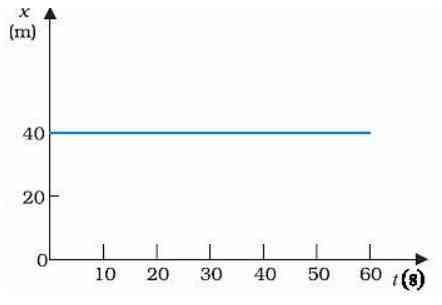
Ans :- If the distance-time graph is a straight line parallel to the time axis, the body is at rest.
3. What can you say about the motion of an object if its speed-time graph is a straight line parallel to the time axis?
Ans :- If the speed-time graph is a straight line parallel to the time axis, the object is moving uniformly.
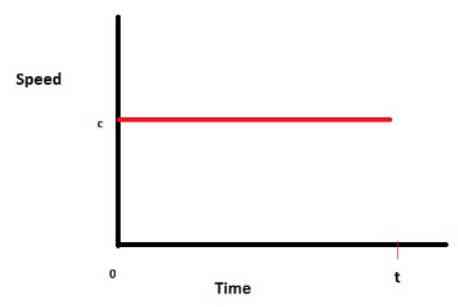
Ans :- If the speed-time graph is a straight line parallel to the time axis, the object is moving uniformly.
4. What is the quantity which is measured by the area occupied below the velocity-time graph?
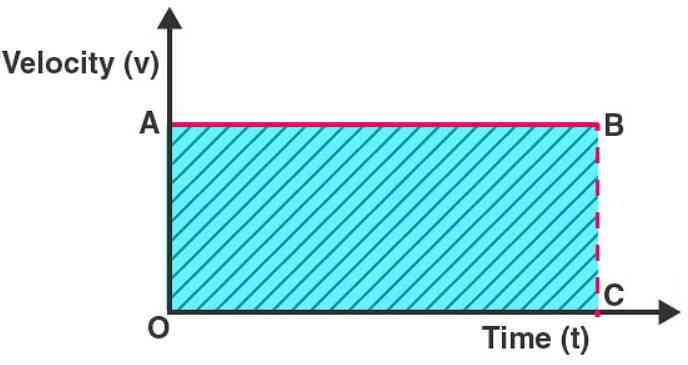
Ans :- The area under velocity-time graph = displacement of the body.
Ans :- The area under velocity-time graph = displacement of the body.
Page No. 76
1. Distinguish between speed and velocity.
Ans :-
Speed is the rate at which an object moves and is defined as the distance traveled per unit of time. It is a scalar quantity, meaning it has only magnitude and no direction.
Velocity, on the other hand, refers to the speed of an object in a specific direction. It is a vector quantity, meaning it has both magnitude and direction.
2. Under what condition(s) is the magnitude of the average velocity of an object equal to its average speed?
Ans :- The magnitude of the average velocity of an object is equal to its average speed when the total distance traveled is equal to the magnitude of displacement. This happens when the object moves in a straight line without changing direction.
3. What does the odometer of an automobile measure?
Ans :- The odometer of an automobile measures the total distance traveled by the vehicle. It records the path length covered, regardless of the direction of motion. Since distance is a scalar quantity, the odometer does not account for displacement (the shortest straight-line distance between the starting and ending points).
4. What does the path of an object look like when it is in uniform motion?
Ans :- When an object is in uniform motion, it moves in a straight line with a constant speed. This means that it covers equal distances in equal intervals of time without changing its direction.
5. During an experiment, a signal from a spaceship reached the ground station in five minutes. What was the distance of the spaceship from the ground station? The signal travels at the speed of light, which is 3 × 10 8 ms -1.
Ans :- We can calculate the distance using the formula: Distance = Speed × Time
Speed of the signal (speed of light) = 3 × 10 8 m/s
Time taken = 5 minutes = 5 × 60 = 300 seconds
Distance=(3×108)×(300) =9×10¹⁰ meters
Page No. 77
1. When will you say a body is in
(i) Uniform acceleration
(ii) Non-uniform acceleration?
Ans :-
(i) Uniform Acceleration : A body is said to be in uniform acceleration when its velocity changes by an equal amount in equal intervals of time. This means the rate of acceleration remains constant throughout the motion.
Examples:
A freely falling object under gravity (acceleration due to gravity = 9.8 m/s²)
A car moving in a straight line and increasing its speed at a constant rate
(ii) Non-Uniform Acceleration A body is said to be in non-uniform acceleration when its velocity changes by unequal amounts in equal intervals of time. This means the rate of acceleration is not constant.
Examples:
A car moving in traffic, where the speed keeps changing unpredictably
A train slowing down at a station, where the rate of decrease in speed varies
A rocket launch, where the acceleration increases as fuel burns and the mass decreases
2. A bus decreases its speed from 80 km h -1 to 60 km h -1 in 5 s. Find the acceleration of the bus.
Ans :-
Ans :-
We use the formula for acceleration:
- Initial velocity () = 80 km/h = = 22.22 m/s
- Final velocity () = 60 km/h = = 16.67 m/s
- Time () = 5 s
The acceleration of the bus is -1.11 m/s², indicating deceleration.
3. A train starting from a railway station and moving with uniform acceleration attains a speed of 40 km/h-1 in 10 minutes. Find its acceleration.
Ans :-
Ans :-
We use the formula for acceleration:
- Initial velocity () = 0 (train starts from rest)
- Final velocity () = 40 km/h = = 11.11 m/s
- Time () = 10 minutes = seconds
The acceleration of the train is 0.0185 m/s².
1. A bus starting from rest moves with a uniform acceleration of 0.1 m s -2 for 2 minutes. Find (a) the speed acquired, (b) the distance travelled.
Ans :-
Ans :-
We use the kinematic equations to solve the problem:
Given:
- Initial velocity () = 0 (bus starts from rest)
- Acceleration () = 0.1 m/s²
- Time () = 2 minutes = seconds
Calculation:
(a) Speed acquired:
(b) Distance travelled:
Answer:
(a) The speed acquired by the bus is 12 m/s.
(b) The total distance travelled by the bus is 720 meters.
2. A train is travelling at a speed of 90 km h -1. Brakes are applied so as to produce a uniform acceleration of –0.5 m s -2. Find how far the train will go before it is brought to rest.
Ans :-
Ans :-
We use the kinematic equation to find the distance:
Given:
- Initial velocity () = 90 km/h =
- Final velocity () = 0 (train stops)
- Acceleration () = -0.5 m/s²
Calculation:
Answer:
The train will travel 625 meters before coming to rest.
3. A trolley, while going down an inclined plane, has an acceleration of 2 cm s -2. What will be its velocity 3 s after the start?
Ans :-
Ans :-
To find the velocity of the trolley after 3 seconds, we use the first equation of motion:
where:
- = initial velocity = cm/s (assuming it starts from rest)
- = acceleration = cm/s²
- = time = s
Substituting the values:
Solving:
So, the velocity of the trolley after 3 seconds is 6 cm/s.
4. A racing car has a uniform acceleration of 4 m s -2. What distance will it cover in 10 s after start?
Ans :-
Ans :-
To calculate the distance covered by a racing car with uniform acceleration, we use the second equation of motion:
where:
- = initial velocity = m/s
- = acceleration = m/s²
- = time = s
Substituting the values:
Solving:
So, the racing car will cover 200 meters in 10 seconds after the start.
5. A stone is thrown in a vertically upward direction with a velocity of 5 m s -1. If the acceleration of the stone during its motion is 10 m s -2 in the downward direction, what will be the height attained by the stone and how much time will it take to reach there?
Ans :-
Ans :-
To determine the height attained by the stone and the time taken to reach there, we use the equations of motion.
Given data:
- Initial velocity,
- Acceleration due to gravity, (negative since it acts downward)
- Final velocity at maximum height,
Finding the Maximum Height:
Using the third equation of motion:
Substituting the values:
So, the maximum height attained by the stone is 1.25 m.
Finding the Time to Reach Maximum Height:
Using the first equation of motion:
So, the time taken to reach the maximum height is 0.5 seconds.
Answer:
- Maximum height attained: 1.25 m
- Time to reach maximum height: 0.5 s
Page No. 85
1. An athlete completes one round of a circular track of diameter 200 m in 40 s. What will be the distance covered and the displacement at the end of 2 minutes 20 s?
Ans :-
To determine the distance covered and displacement of the athlete, we consider the circular track motion.
Given data:
- Diameter of the track,
- Radius of the track,
- Time for one complete round,
- Total time given,
Finding the Distance Covered:
The circumference of the circular track is given by:
Number of rounds completed in 140 s:
So, the total distance covered:
Approximating :
Finding the Displacement:
Since the athlete completes 3.5 rounds, he reaches the point exactly opposite to his starting point.
The displacement is the diameter of the circular track:
Answer:
- Distance covered: 2198 m
- Displacement: 200 m
2. Joseph jogs from one end A to the other end B of a straight 300 m road in 2 minutes 30 seconds and then turns around and jogs 100 m back to point C in another 1 minute. What are Joseph’s average speeds and velocities in jogging (a) from A to B and (b) from A to C?
Ans :-
Ans :-
To determine Joseph’s average speed and velocity, we use the formulas:
Average Speed:
Average Velocity:
Given Data:
- Distance from A to B = m
- Time from A to B =
- Distance from B to C = m
- Time from B to C =
(a) From A to B:
Average Speed:
Average Velocity:
(b) From A to C:
Total Distance Travelled =
Total Time Taken =
Average Speed:
Displacement from A to C:
Average Velocity:
Final Answer:
- From A to B:
- Average Speed = 2 m/s
- Average Velocity = 2 m/s
- From A to C:
- Average Speed = 1.90 m/s
- Average Velocity = 0.95 m/s
3. Abdul, while driving to school, computes the average speed for his trip to be 20 km.h–1. On his return trip along the same route, there is less traffic and the average speed is 30 km.h -1. What is the average speed for Abdul’s trip?
Ans :-
Ans :-
To determine the average speed for Abdul’s entire trip, we use the formula for average speed when distances are equal:
Given Data:
- Speed while going to school,
- Speed while returning,
Substituting the values:
Answer:
- Average speed for Abdul’s entire trip: 24 km/h
4. A motorboat starting from rest on a lake accelerates in a straight line at a constant rate of 3.0 m s -2 for 8.0 s. How far does the boat travel during this time?
Ans :-
Ans :-
To determine the distance traveled by the motorboat, we use the second equation of motion:
Given Data:
- Initial velocity,
- Acceleration,
- Time,
Substituting the values:
Answer:
- Distance traveled by the boat: 96 m
7. A ball is gently dropped from a height of 20 m. If its velocity increases uniformly at the rate of 10 m s -2, with what velocity will it strike the ground? After what time will it strike the ground?
Ans :-
Ans :-
To determine the velocity with which the ball strikes the ground and the time taken, we use the equations of motion.
Given Data:
- Initial velocity, (since the ball is dropped gently)
- Acceleration due to gravity,
- Height,
Finding the Final Velocity:
Using the third equation of motion:
Substituting the values:
Finding the Time to Reach the Ground:
Using the first equation of motion:
Answer:
- Velocity upon striking the ground: 20 m/s
- Time taken to reach the ground: 2 seconds
9. State which of the following situations are possible and give an example for each of these: (a) an object with a constant acceleration but with zero velocity (b) an object moving with an acceleration but with uniform speed. (c) an object moving in a certain direction with an acceleration in the perpendicular direction.
Ans :-
Ans :-
(a) An object with a constant acceleration but with zero velocity:
Yes, this is possible. An example is a ball thrown vertically upwards. At the highest point, its velocity is zero, but it still experiences a constant acceleration due to gravity (9.8 m/s² downward).
(b) An object moving with an acceleration but with uniform speed:
No, acceleration implies a change in velocity, and uniform speed means that the magnitude of velocity is constant. However, in uniform circular motion, an object moves at a constant speed but experiences acceleration due to the continuous change in direction.
(c) An object moving in a certain direction with an acceleration in the perpendicular direction:
Yes, this is possible. An example is a satellite moving in a circular orbit around a planet. The satellite moves tangentially to the orbit while experiencing a centripetal acceleration directed toward the center of the planet.
10. An artificial satellite is moving in a circular orbit of radius 42250 km. Calculate its speed if it takes 24 hours to revolve around the earth.
Ans :-
Ans :-
Calculation of the speed of an artificial satellite:
Given Data:
- Radius of the orbit,
- Time period,
Finding the Circumference of the Orbit:
The distance traveled by the satellite in one complete revolution is given by the circumference of the circular orbit:
Finding the Speed:
The speed of the satellite is given by:
Substituting the values:
Answer:
- Speed of the satellite: 11061 km/h
No MCQs available for this topic yet.
← Back to Science Chapters