🎯 Audience Engagement & Q&A · Lesson 2 of 5
Managing Q&A Sessions
Q&A is not when your presentation ends — it is the most interactive part of it. A well-managed Q&A demonstrates mastery of your subject. A poorly managed one can undo a strong speech.
🗂️
The ABCD Q&A Framework
The diagram shows the four steps that structure any Q&A answer — from acknowledging the question to directing cleanly to the next one. The framework is simple enough to use automatically under pressure.
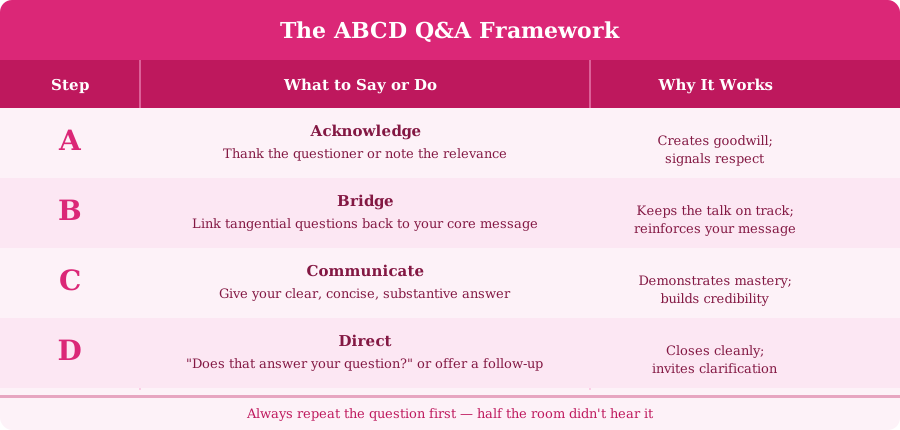
💡 Tip: In any room with more than 20 people, always repeat or paraphrase the question before answering. Half the room didn't hear it. Repeating it also gives you a few seconds to formulate your answer — and lets you subtly reframe a confusingly-worded question.
🎯
Worked Example: ABCD Applied in Real Time
Topic: 'Why most professionals will never use AI effectively.' A question comes from the back: 'Isn't AI just replacing us anyway — what's the point of learning to use it?'
ABCD framework — live application: A — Acknowledge:
'That's a fair question — and I know it's on a lot of people's minds.'
B — Bridge:
'It's connected directly to what I said about the 12% — the gap between people who use AI as a tool and those who are being replaced by it is exactly this skill.'
——
C — Communicate:
'The people being displaced by AI are doing tasks that AI can automate. The people directing AI are the ones who understood early that the skill is judgment, not execution. That is what this is about.'
D — Direct:
'Does that address the concern, or do you want to dig into the specific roles most at risk?'
📌
Three Rules That Keep Q&A on Your Terms
Most Q&A sessions go wrong not because of hard questions, but because of lack of structure at the start and end.
- ✓Announce the Q&A format at the start of your talk — 'I'll take questions at the end — we'll have about 10 minutes.' This prevents mid-talk interruptions and sets expectations
- ✓Never end the session on a Q&A answer — After the last question, always reclaim the floor: 'One final thought before we close...' and deliver your prepared closing. The last thing the audience hears should be yours, not a questioner's.
- ✓If no one asks first, seed it yourself — 'A question I often get asked is...' — answers a real question, breaks the silence, and models that questions are welcome
Key Takeaways
- 1ABCD: Acknowledge → Bridge → Communicate → Direct — use this sequence for every answer
- 2Always repeat or paraphrase the question — half the room didn't hear it; it also buys you thinking time
- 3Announce the Q&A format at the start of the talk, not at the end
- 4Never end on a Q&A answer — reclaim the floor and deliver your prepared closing
- 5If no one asks first, seed the first question yourself to break the silence
What's Next
Continue through the course in order, or jump back to review earlier lessons.