🎯 Audience Engagement & Q&A · Lesson 4 of 5
Reading Audience Feedback
A speech is not a monologue — it is a conversation with many people at once. The audience is constantly responding. Skilled speakers read those responses and adjust their delivery in real time.
👀
Eight Signals — Engaged vs Disengaged
The diagram shows four engaged signals on the left and four disengaged signals on the right. In a real room, you will see both simultaneously from different sections — the skill is reading the pattern, not the individual.
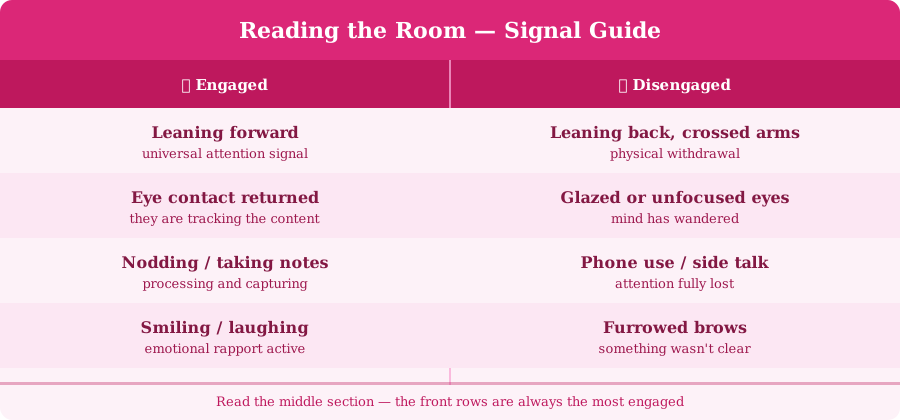
💡 Tip: Furrowed brows are not disengagement — they are confusion. Respond to them differently: slow down and add an example. Glazed eyes are disengagement: add energy or an interaction point. The response differs, so the diagnosis matters.
🎯
Worked Example: Reading the Room at the 12-Minute Mark
Topic: 'Why most professionals will never use AI effectively.' Here is what reading the room looks like at 12 minutes into a 20-minute talk.
Mid-talk signal read — 12 minutes in: [The front row: leaning in, two people taking notes. Engaged.]
[The middle section: mixed. Three people nodding, two looking at phones.]
[The back row: three side conversations. One person has been on their laptop for 4 minutes.]
——
Diagnosis: the front rows are with you; the middle is drifting; the back is lost.
This is a room that has heard the concept and is waiting for the practical implication.
Response: 'Let me skip ahead to the part most of you are actually wondering about: what do you do with this on Monday morning?'
[Side conversations stop. The back row looks up.]
📊
How to Read the Room Accurately
Common mistakes in reading audiences — and the corrections that produce an accurate read.
- ✓Read patterns, not individuals — One person on their phone is a habit. Five people on their phones is a signal. One person nodding is politeness. Half the room nodding is confirmation.
- ✓Read the middle, not the front — Front row volunteers are self-selected enthusiasts — they will engage regardless. The middle section is representative of the real room.
- ✓Watch for the moment energy shifts — Engagement rarely drops uniformly — it drops at a specific moment. Identifying when it dropped tells you what caused it.
Key Takeaways
- 1Engaged: leaning forward, eye contact returned, nodding, note-taking, smiling
- 2Disengaged: leaning back, glazed eyes, phone use, side conversations
- 3Furrowed brows = confusion (slow down, add an example) — not the same as disengagement
- 4Read the middle section — the front rows are always more engaged than the room average
- 5Read patterns, not individuals — one signal is noise; the same signal from five people is data
What's Next
Continue through the course in order, or jump back to review earlier lessons.