🎯 Audience Engagement & Q&A · Lesson 1 of 5
Interactive Techniques
The more an audience participates, the more they invest in your message. Passive listening creates passive retention. Active participation creates ownership of the ideas.
🙋
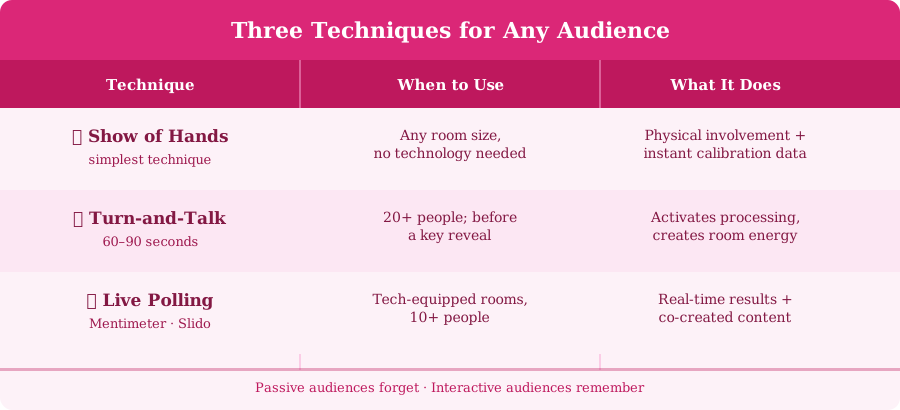
Three Techniques for Any Audience
The diagram shows three techniques ranked from simplest to most tech-dependent. Each serves a different purpose and works in a different context — but all share the same mechanism: they make the audience do something.
💡 Tip: Always raise your own hand when asking the audience to raise theirs. You model the behavior and remove the 'who goes first' hesitation. The technique fails most often because the speaker asks without leading.
🎯
Worked Example: Using All Three Techniques in One Talk
Topic: 'Why most professionals will never use AI effectively.' Here is how all three techniques fit into one 20-minute talk.
Three interaction points in a 20-minute AI talk: [Opening — 90 seconds in]
'Raise your hand if you've used an AI tool at work in the last month.' [Pause. About 80% of hands go up.]
'Keep it up if you used it more than three times.' [About 40% remain.]
'That gap — between trying it once and using it consistently — is what this talk is about.'
——
[Before the 12% finding — 7 minutes in]
'Before I share the number — turn to the person next to you and estimate: what percentage of professionals do you think use AI effectively? 60 seconds.'
[Collect 2 estimates from the room. Then reveal: 12%.]
[Mentimeter poll — 15 minutes in]
'One question on your phone: what is the single biggest barrier in your team? Vote now.'
[Word cloud appears. The room reads its own answer. No slide needed.]
📌
Three Rules for Any Interactive Technique
Interaction fails when it feels forced, slows the talk, or goes unanswered. Follow these rules and it works every time.
- ✓Use it before a reveal, not after — Turn-and-talk and polling land hardest when the audience has already engaged with the question and now wants the answer
- ✓Always debrief what you see — Don't ignore the hands or poll results — comment on them: 'Interesting — about half of you said X. Here's why that might be.' The interaction is only valuable if you use it.
- ✓One interaction every 8–10 minutes maximum — More than that and it starts to feel like a workshop exercise, not a talk. The technique resets attention — use it when attention needs resetting.
Key Takeaways
- 1Active participation creates ownership — passive audiences forget, interactive audiences remember
- 2Show of Hands: simplest technique, works in any room, no tech — always raise your own hand first
- 3Turn-and-Talk before a reveal: 60 seconds with a neighbor activates processing and creates investment in your answer
- 4Always debrief the interaction — the hands or poll result is only useful if you reference it
- 5One interaction point every 8–10 minutes maximum — any more and it becomes a workshop, not a talk
What's Next
Continue through the course in order, or jump back to review earlier lessons.