📖 Content & Storytelling · Lesson 3 of 8
Analogies & Metaphors
A good analogy does in ten words what three paragraphs cannot. It connects something the audience already understands to something they do not — and the idea lands instantly.
🌉
Same Idea — Without and With Analogy
An analogy works by borrowing understanding the audience already has. The diagram below shows three AI concepts explained technically, then through a simple analogy.
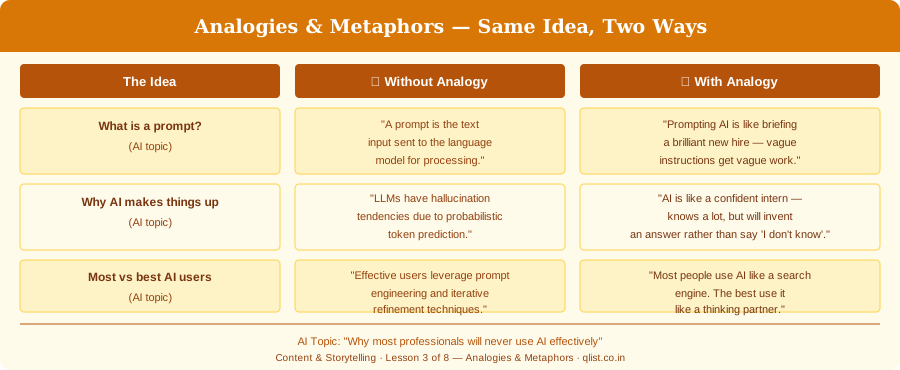
💡 Tip: The more unfamiliar the concept, the more familiar your analogy needs to be. If your audience has never used AI, compare it to something they do every day.
🎯
Worked Example: Building the Analogy Live
Topic: 'Why most professionals will never use AI effectively.' Here is how a metaphor can carry the entire argument.
Full delivery using the 'brilliant new hire' analogy: "Imagine you hired someone brilliant — top of their field, reads everything, never gets tired.
But on day one, you just say: 'Do stuff.'
They would do something. But probably not what you needed.
That is exactly how most people use AI.
They give it a one-line prompt and expect expert output. The tool is not the problem. The briefing is.
Learn to brief it well, and that brilliant new hire becomes the most productive person on your team."
⚠️ Watch out: Do not force an analogy. If it requires three sentences to set up, it is probably not the right one. The best analogies need no explanation — the audience sees the connection immediately.
✏️
How to Build Your Own Analogy
Three steps to find an analogy that works for any complex idea.
- ✓Identify the one thing to transfer — What is the single most important property of the concept? Prompting = the quality of your instructions
- ✓Find a universal parallel — What familiar experience shares that property? Briefing a new hire, directing a chef, writing a job spec — all share 'quality in = quality out'
- ✓Test where it breaks — Where does the analogy stop being accurate? Acknowledge it if the audience is likely to find it: 'unlike a real hire, AI never learns your preferences unless you tell it each time'
Key Takeaways
- 1Analogies transfer existing knowledge — the audience already understands your comparison, so they instantly understand your concept
- 2The more unfamiliar the topic, the more everyday and familiar the analogy must be
- 3One strong metaphor can carry an entire argument — 'AI as a brilliant new hire' frames the whole talk
- 4Test where your analogy breaks down and acknowledge it — the audience will trust you more for it
- 5If an analogy needs more than one sentence to set up, find a simpler one
What's Next
Continue through the course in order, or jump back to review earlier lessons.