📖 Content & Storytelling · Lesson 4 of 8
Humor in Speeches
Humor is not about being funny — it is about connection. A well-placed observation that gets one smile does more for audience rapport than five impressive statistics.
😄
Three Safe Types of Humor
Most professional speakers rely on three types of humor that work across any audience. The diagram shows each type with an worked example — and what to avoid alongside it.
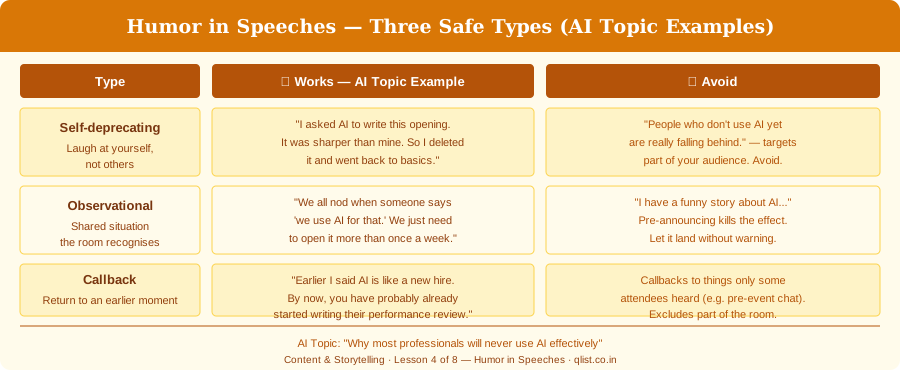
💡 Tip: Never pre-announce humor. Saying 'I have a funny story' sets an expectation the joke must then meet. Let the observation land without warning.
🎯
Worked Example: Self-Deprecating Humor in Context
Topic: 'Why most professionals will never use AI effectively.' Self-deprecating humor is safest because you are the target.
Opening with self-deprecating humor: "Before I started preparing this talk, I asked AI to write the opening for me.
Pause.
It was better than mine.
Pause.
So I deleted it, started over, and remembered why I still need to think for myself.
Which is exactly what I want to talk about today."
⚠️ Watch out: The humor works because it is true, it is on you, and it leads directly into the talk's argument. Humor that has nothing to do with your topic is just a detour.
⏱️
The One Delivery Rule: Pause
Timing is not about speed. It is about the pause. A one-second pause before the unexpected word and a two-second pause after it gives the audience time to react.
- ✓Setup slowly — Deliver the normal-sounding opening line at your usual pace — no telegraphing
- ✓Pause before the twist — One beat of silence creates unconscious anticipation
- ✓Deliver the unexpected part — Slightly faster than the setup — surprise needs momentum
- ✓Pause after — Two full seconds — let the reaction arrive before you move on
Key Takeaways
- 1The goal is a smile, not a laugh — connection, not comedy performance
- 2Self-deprecating humor is the safest type in professional contexts — you are the only target
- 3Observational humor works when the whole room recognises the shared truth
- 4Never pre-announce humor — 'I have a funny story' sets up the joke to fail
- 5Pause before and after the humorous moment — let the reaction arrive, do not rush past it
- 6If a joke does not land, keep a neutral face and continue — never acknowledge the silence
What's Next
Continue through the course in order, or jump back to review earlier lessons.