📖 Content & Storytelling · Lesson 6 of 8
Citing Sources Credibly
In a speech, your claims exist only in the air — there is no footnote the audience can check. A brief, specific source citation turns a claim from your opinion into established evidence.
🏛️
Weak vs Strong — Worked Examples
The same claim sounds very different with a vague citation versus a specific one. The diagram shows three common situations and how to handle each.
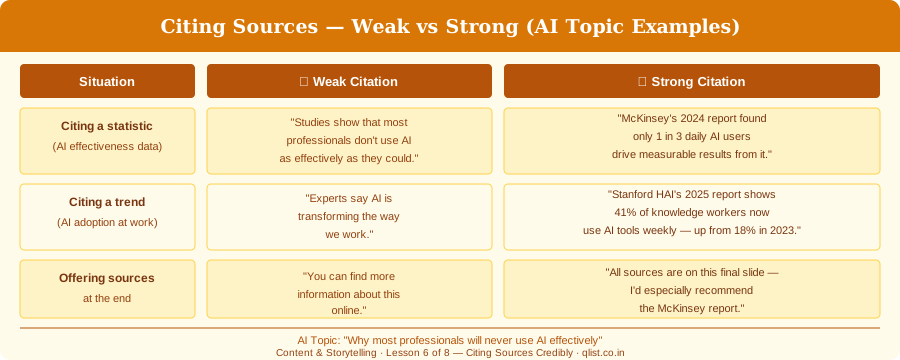
💡 Tip: The format that works: Organisation + Year + Finding. 'McKinsey 2024 found...' is three words and full credibility. Never say 'studies show' — name the study.
🎯
Worked Example: Citations Woven Into Delivery
Topic: 'Why most professionals will never use AI effectively.' Here is a passage where two citations are woven in naturally without breaking the narrative.
Natural in-speech citation delivery: "McKinsey's 2024 report found that only 1 in 3 professionals who use AI daily actually drive measurable results from it.
That is the tool adoption gap. Most people have the subscription. Far fewer have the skill.
Stanford HAI's 2025 data shows 41% of knowledge workers now use AI tools weekly — up from 18% in 2023. The adoption is accelerating. The effectiveness is not keeping pace.
All the sources I cite today are on the final slide. I'd especially encourage you to read the McKinsey report — it is fifteen pages and will change how you think about your own team."
⚠️ Watch out: Do not read citations off a slide while speaking. State the source verbally, keep eye contact, and let the slide hold the detail for anyone who wants to verify it.
📋
Three Rules for Clean Citations
Keep citations brief, honest, and easy to follow up.
- ✓Name the source — never 'studies show' — Audiences now fact-check in real time. Vague authority claims fail the moment someone searches and finds nothing
- ✓Put full references on a slide or handout — Verbal citation builds credibility; written reference lets the audience verify — give them both
- ✓Never read a URL aloud — No one can transcribe a URL from speech — use a QR code, a short link, or a reference page instead
Key Takeaways
- 1Use Organisation + Year + Finding: 'McKinsey 2024 found...' — three words, full credibility
- 2Never say 'studies show' — audiences fact-check in real time; name the specific study
- 3Cite verbally in two to four words; put the full reference on a final sources slide
- 4Never read a URL aloud — use a QR code or short link the audience can photograph
- 5Keep eye contact when citing — do not look at the slide to read your own source
What's Next
Continue through the course in order, or jump back to review earlier lessons.