📖 Content & Storytelling · Lesson 8 of 8
Tailoring Language to Your Audience
The best content fails if the language does not fit the room. Vocabulary, framing, and tone are not stylistic choices — they determine whether the audience hears your message as relevant or as noise.
🎚️
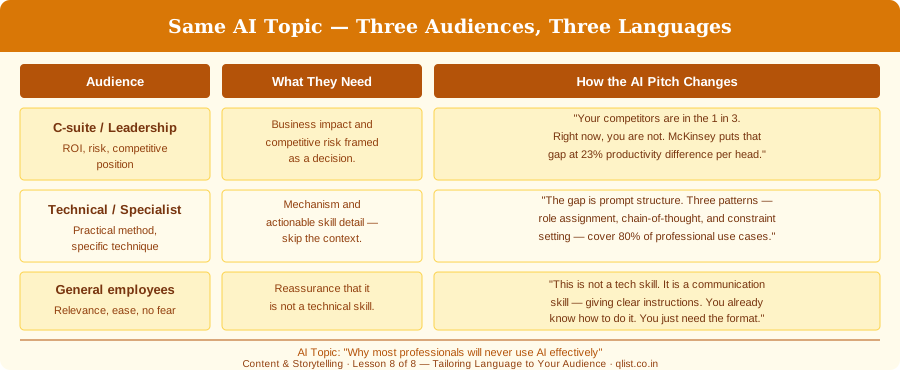
Same Topic — Three Audiences, Three Languages
The same argument about AI effectiveness sounds completely different to a C-suite, a technical team, and general employees. The diagram shows how the pitch shifts for each.
💡 Tip: Find out how your audience already talks about the topic before you prepare. Use their vocabulary, not yours. Jargon signals expertise to peers and exclusion to everyone else.
🎯
Worked Example: Reframed for General Employees
Topic: 'Why most professionals will never use AI effectively.' Here is how the same argument sounds when reframed for an audience with no technical background.
Language tailored for general employees (no jargon, reassurance first): "I want to clear something up before we start.
This is not a technology session. You are not going to learn how AI works. You do not need to.
What I am going to show you is how to give better instructions — because that is all that separates the people who get great results from AI and the people who do not.
You already know how to give a clear brief to a colleague. This is the same skill. You just need to see the format.
By the end of today, you will have three sentences that will change every AI interaction you have from this point."
⚠️ Watch out: Avoid using technical vocabulary and then defining it mid-sentence — it signals you forgot your audience. Rewrite for them entirely; do not patch over jargon with definitions.
🔍
Two Questions Before You Write
Every language decision in your speech should flow from two questions answered before you write a word.
- ✓What vocabulary do they already use for this topic? — C-suite says 'productivity gap' and 'competitive risk'; technical teams say 'prompt engineering' and 'context window'; general employees say 'AI stuff' and 'ChatGPT' — use their words
- ✓What do they need to feel before they will act? — Leadership needs confidence in the ROI; technical teams need to feel the method is sound; general employees need to feel it is not threatening or beyond them
Key Takeaways
- 1The same argument must be reframed entirely for each audience — patching jargon with definitions is not the same as tailoring
- 2Use the vocabulary your audience already uses for the topic — find this out before you prepare
- 3Jargon builds credibility with peers; it signals exclusion to everyone else
- 4Ask what the audience needs to feel before they will act — and design the language around that
- 5When in doubt, use plain language — experts are never offended by clarity, non-experts are always lost by jargon
What's Next
Continue through the course in order, or jump back to review earlier lessons.