📖 Content & Storytelling · Lesson 2 of 8
Using Data & Statistics
A number by itself means nothing. Context, translation, and a source are what turn a statistic into evidence the audience actually remembers.
📊
Three Rules for Numbers That Land
Most presenters use data badly — either listing too many stats or quoting raw numbers with no frame. Three rules fix this every time.
- ✓Pick ONE stat per claim — Multiple numbers in a row cause cognitive overload — audiences stop processing after the second one
- ✓Translate to human scale — Convert to a ratio, per-person figure, or time frame: '1 in 3' lands harder than '34%'
- ✓Source it briefly — 'McKinsey 2024 found...' is enough — reading a URL or full citation breaks your delivery
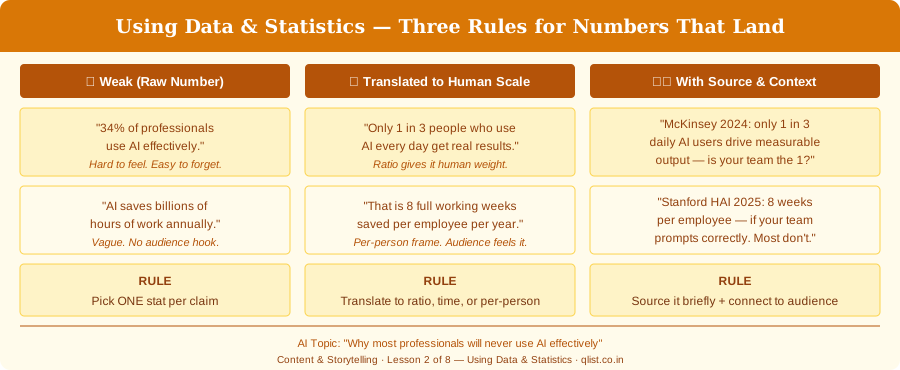
💡 Tip: After you write any statistic, ask: can I turn this into a ratio, a per-person number, or a time frame? If yes, do it.
🎯
Weak vs Strong — Worked Example
Topic: 'Why most professionals will never use AI effectively.' Here is how the same statistic sounds weak, then strong.
Weak delivery (raw number, no source, no frame): "A lot of studies show that most professionals don't really use AI in a meaningful way. The numbers are actually pretty bad when you look at them."
⚠️ Watch out: Vague claims without a number feel like opinion. A number without a source feels made-up. Both lose the audience.
✅
Strong Delivery — One Stat, Translated, Sourced
Here is the same point rewritten using all three rules.
- ✓One stat only — '1 in 3' — no second number follows it
- ✓Translated — '1 in 3' instead of '34%' — ratio is felt, percentage is processed
- ✓Sourced briefly — 'McKinsey 2024' — two words, full credibility
- ✓Connected to the room — "Two people in this room" — abstract data becomes present and personal
Strong delivery (one stat, human scale, brief source, audience hook): "McKinsey's 2024 report found that only 1 in 3 professionals who use AI every day actually drive measurable results from it.
Pause.
That means two people in this room — if three of you use AI — are not in that group. Yet.
The difference is not the tool. It is how they prompt it."
Key Takeaways
- 1Use ONE statistic per claim — more than two in a row and audiences stop absorbing them
- 2Translate percentages to ratios or per-person figures: '1 in 3' lands harder than '34%'
- 3Source every stat in two words: 'McKinsey 2024' or 'Stanford HAI 2025' is enough
- 4Connect the data to the room: 'that means two people here...' makes abstract data present
- 5Never read numbers off a slide — pause, let the audience see it, then speak to what it means
What's Next
Continue through the course in order, or jump back to review earlier lessons.