Reading the Room
A prepared speech delivered to a disconnected audience is a wasted speech. Reading the room is the real-time skill that separates good speakers from great ones.
Signal & Response — 4 Scenarios
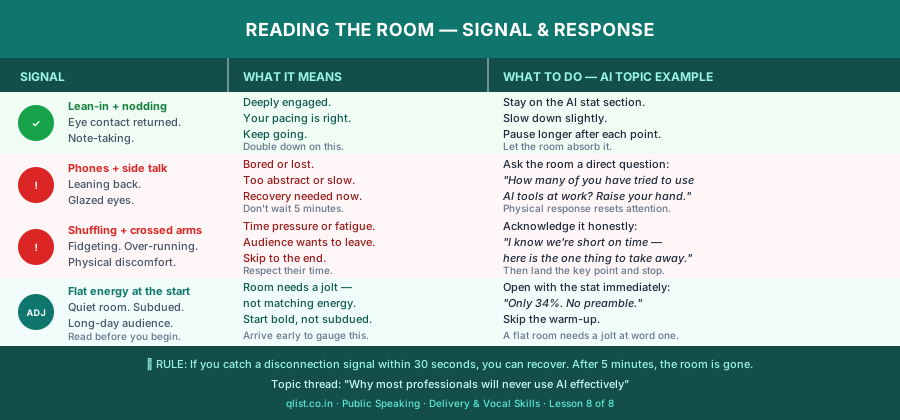
Every audience gives constant feedback — most speakers just are not trained to read it. The diagram maps four key signals (two good, two bad) to what each means and what to do next, with a live example from the sample speech.
The 3 Recovery Moves
When you spot disconnection, you have three tools that work without breaking your speech or drawing attention to the problem.
- ✓Ask a direct question — "How many of you have tried an AI tool at work — raise your hand." A physical response resets the room instantly. Use this first.
- ✓Drop to a whisper — A sudden drop in volume forces everyone to lean in and pay attention. More effective than raising your voice.
- ✓Acknowledge and fast-forward — "I know we're short on time — here is the one thing to take away." Then land the key point and stop. Respecting the audience's time earns more trust than finishing your script.
Cultural Context
Audience engagement signals vary significantly by culture. Applying the wrong interpretation can cause a speaker to fix a problem that does not exist — or miss one that does.
Key Takeaways
- 1Engagement signals: leaning forward, eye contact held, nodding, note-taking
- 2Disconnection signals: phone use, side talk, glazed eyes, crossed arms, shuffling
- 3The 30-second rule: catch a disconnection early and one move recovers it; after 5 minutes the room is lost
- 4Three recovery moves: direct question, volume drop, honest fast-forward to the key point
- 5Silence does not always mean boredom — research cultural norms before interpreting body language
What's Next
Continue through the course in order, or jump back to review earlier lessons.