🤝 Nonverbal Communication · Lesson 3 of 8
Facial Expressions
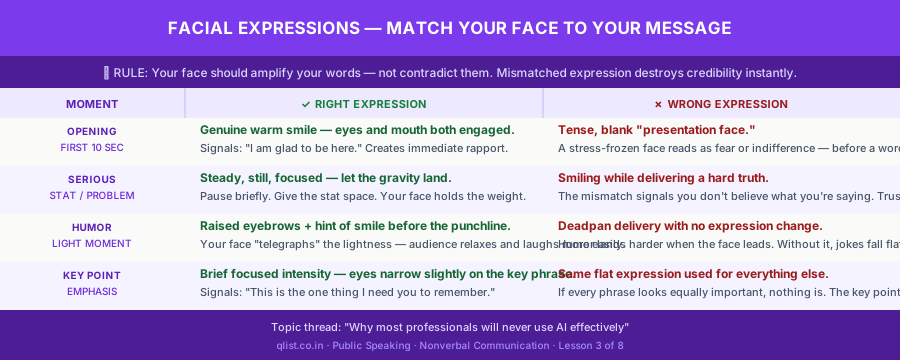
Your face should amplify your words, not contradict them. A mismatched expression — smiling while delivering hard facts, or frozen blankness during a warm opening — destroys credibility faster than any verbal mistake.
😊
Match Your Face to the Moment
Different moments in a speech require different facial energy. The diagram maps four common moments to the right expression — and shows exactly what the wrong expression looks like and why it fails.
💡 Tip: Before speaking, do a face scrunch: tighten all facial muscles hard for 3 seconds, then release completely. Repeat twice. This breaks the stress-frozen face that most speakers default to when nervous.
🎤
The Mismatch in Action — Worked Example
The same sentence from the sample speech lands completely differently depending on whether the face matches the content.
Delivering the key stat: "Only 34% of professionals use AI effectively.": MISMATCHED DELIVERY:
Speaker smiles warmly while saying:
"Only 34% of professionals use AI effectively."
Result: The audience doesn't know whether to take this seriously. The smile signals it might be fine. The stat loses its weight.
MATCHED DELIVERY:
Speaker pauses. Face goes still and focused. Holds eye contact.
"Only 34%."
Another pause. Same still expression.
"That is the problem we're here to solve today."
Result: The stat lands. The room goes quiet. Everyone feels the gravity before the next line.
⚠️ Watch out: The frozen 'presentation face' is a stress response — the face stops moving when the brain is under cognitive load. It reads as fear or indifference to every person in the room.
📹
How to Practise — The Video Method
Facial expression is nearly impossible to self-monitor in real time. There is only one reliable way to improve it.
- ✓Record at least 5 minutes of yourself speaking — Short clips don't capture habitual patterns. You need enough footage to see your defaults.
- ✓Watch it once with sound off — Observe only your face, divorced from your words. What does your face signal? Does it match the content you were delivering?
- ✓Find your freeze moments — When does your face go blank? Usually at transitions, complex content, or under pressure. Those are the moments to practise specific expressions.
Key Takeaways
- 1Face scrunch warm-up: tighten all muscles for 3 seconds then release — prevents frozen presentation face
- 2Opening: genuine warm smile (eyes and mouth) — a forced mouth-only smile reduces trust
- 3Serious content: still, steady, focused — never smile while delivering a hard fact
- 4Humor: raise eyebrows and hint at a smile before the punchline — your face leads the laugh
- 5Watch video of yourself with sound off — your face tells a different story than you think
What's Next
Continue through the course in order, or jump back to review earlier lessons.