🤝 Nonverbal Communication · Lesson 5 of 8
Movement & Use of Space
Where you stand on stage carries meaning. Every movement is a signal — to transition, to emphasise, to connect. Random movement signals anxiety; purposeful movement commands the room.
🗺️
The Three-Zone Stage Map
Professional speakers mentally divide the stage into three zones and assign meaning to each. Moving between zones with intention turns physical position into a storytelling tool.
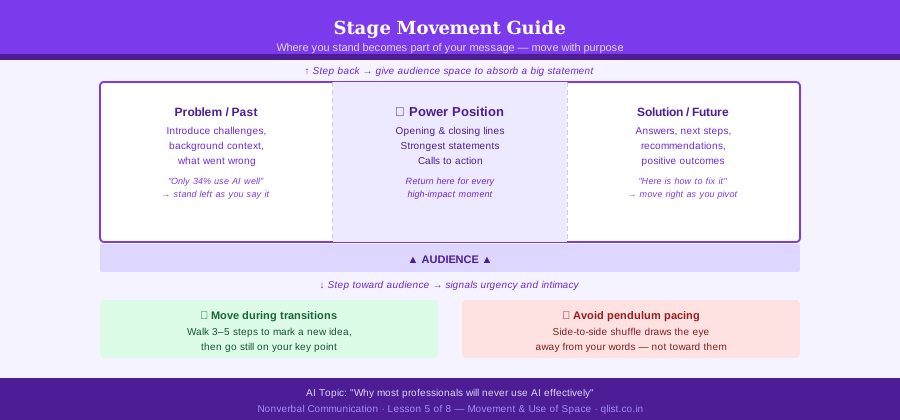
💡 Tip: Always return to centre stage for your most important lines — opening statement, key statistic, call to action. The centre is the visual anchor of the whole presentation.
🎤
The Zone Shift in Action — Worked Example
The same speech on AI effectiveness becomes far more structured when the speaker uses zone movement to separate the problem from the solution.
Speech on AI effectiveness — using zone movement to separate problem and solution: PROBLEM SECTION (move to left):
Speaker walks 3 steps left, goes still.
"Only 34% of professionals use AI effectively. Most invest in the tools — but not in the thinking."
Audience mentally tags: left side = the problem.
TRANSITION (return to centre):
Speaker pauses. Walks back to centre. Goes still.
"Here is what separates the 34% from everyone else."
Audience sits forward — the solution is coming.
SOLUTION SECTION (move to right):
Speaker walks 3 steps right.
"It is not skill with the software. It is knowing which questions to ask."
The physical move signals: we have crossed from problem to answer.
⚠️ Watch out: Never move while delivering your most important line. Walking and speaking a key point simultaneously halves the impact of both. Stop. Say it. Then move.
📋
Two Movement Rules That Cover Most Situations
You do not need a choreographed stage plan. Two rules handle almost every speaking situation.
- ✓Move during transitions, be still on key points — Walk 3–5 deliberate steps as you move from one idea to the next. Then plant your feet and deliver the point from stillness. The contrast makes both the movement and the content more noticeable.
- ✓Step toward the audience for urgency, step back to give them space — Moving forward closes the distance and signals intensity — use it sparingly, on your most important moments. Stepping back after a big statement gives the audience room to absorb it before you continue.
Key Takeaways
- 1Three zones: left = problem/past, centre = power position, right = solution/future
- 2Return to centre stage for every high-impact moment — opening, key stat, call to action
- 3Move during transitions between ideas; go still while stating each key point
- 4Step toward the audience for urgency; step back after a big statement to give them space
- 5Never walk and deliver your most important line at the same time — stop, say it, then move
What's Next
Continue through the course in order, or jump back to review earlier lessons.