📊 Visual Aids & Technology · Lesson 2 of 8
The Rule of Minimalism
The most powerful slides are often the simplest. Minimalism in slide design is not aesthetic preference — it is a cognitive strategy. Every element that is not essential consumes attention that should be on your message.
✂️
The Elimination Test — Remove Everything That Doesn't Serve the Idea
The diagram shows the same slide content before and after applying the elimination test across four slide elements: title, bullets, colors, and images.
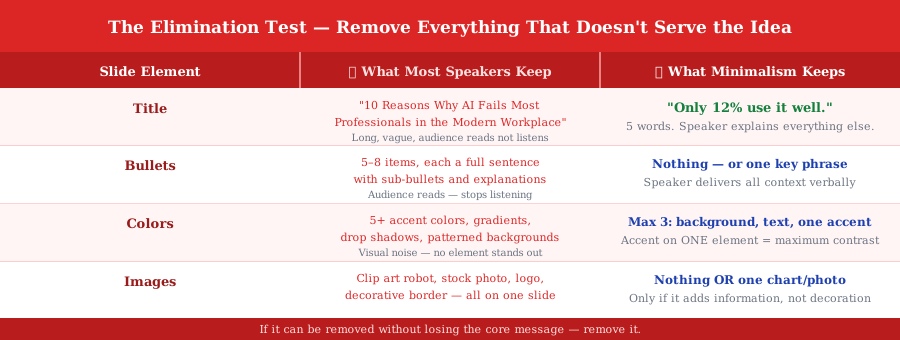
💡 Tip: After finishing a slide, ask: 'What can I remove without losing the core message?' Remove it. Repeat until nothing further can be removed without loss.
🎯
Worked Example: Minimal vs Cluttered Opening Slide
Topic: 'Why most professionals will never use AI effectively.' Here is the same opening slide in cluttered and minimal form.
Cluttered vs Minimal — same content, opposite effect: ✗ CLUTTERED:
Title: "10 Reasons AI Fails Most Professionals"
Bullets: 72% lack training · 40% productivity gap · simple tasks only · no culture · prompt quality is key
Colors: blue header, orange bullets, grey sub-bullets, red accent, gradient background
Images: robot clip art + company logo
——
✓ MINIMAL:
Title: "Only 12% use it well."
Body: Nothing — or a single bar chart (72% vs 12%)
Color: White background, dark text, one red accent on the number
The speaker explains everything else.
📐
Three Numbers to Memorise
These three constraints produce minimal, effective slides every time.
- ✓Maximum 3 colors — Background, primary text, one accent — used on the single most important element only
- ✓Maximum 2 fonts — One for headlines, one for body — never more, never decorative display fonts
- ✓At least 50% whitespace per slide — Half the slide should be empty — whitespace is not wasted space, it is emphasis through contrast
Key Takeaways
- 1Every element that isn't essential is noise — apply the elimination test after every slide
- 2Ask: 'What can I remove without losing the core message?' Remove it. Repeat.
- 3Max 3 colors, max 2 fonts, at least 50% whitespace — three constraints that work
- 4A single number or phrase on a white slide has maximum attention — minimalism creates impact through contrast
- 5Cluttered slides signal unclear thinking; minimal slides signal confident preparation
What's Next
Continue through the course in order, or jump back to review earlier lessons.