📊 Visual Aids & Technology · Lesson 3 of 8
Using Props Effectively
A prop makes the abstract concrete. It creates a physical, tangible anchor for your idea — and the memory of the prop survives long after the exact words are forgotten. Most speakers never use them. That is an opportunity.
🎁
Using a Prop — Three Moments, Three Jobs
Every prop has three phases. The diagram shows exactly what to say and do at each moment, using this example as the example.
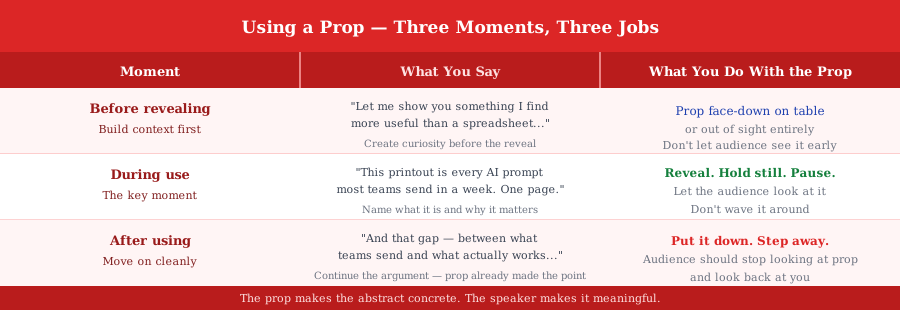
💡 Tip: The moment you put the prop down and step away, the audience looks back at you. That is the moment you make your main point. Prop → reveal → put down → land the argument.
🎯
Worked Example: A Printed Prompt
Topic: 'Why most professionals will never use AI effectively.' Here is a prop sequence using a single printed sheet.
Prop: one printed A4 page — the most common AI prompt format: [Prop face-down on table. Speaker opens:]
"Before I show you anything, I want to describe something I see constantly."
"When I ask teams to show me how they use AI, I get one of two things. Some people type a single sentence and hit enter. Others have a structured format — a context, a task, a constraint, an output format. One sentence. Or four."
[Picks up sheet and holds it still.]
"This is the four-part format. Every professional in this room could learn it in the next five minutes."
[Puts sheet down. Steps slightly back.]
"And that is the entire gap. Not technology. Not access. Four sentences versus one."
🔑
Three Rules for Prop Use
Mishandled props distract. These three rules keep the prop working for you.
- ✓Keep it hidden until the moment of reveal — If the audience sees it early, curiosity turns to distraction — they stop listening and start studying the prop
- ✓Hold still when you reveal it — give the audience a moment to look — Waving it around or moving while holding it makes it impossible to see clearly
- ✓Put it down and step away when you are done — The prop's job is finished — if you keep holding it, the audience keeps looking at it instead of listening to you
Key Takeaways
- 1A prop creates a physical anchor — the memory of the object survives long after the exact words fade
- 2Three moments: build context (hidden), reveal and hold still (pause), put down and step away (make the point)
- 3Never let the audience see the prop before the reveal — curiosity is the setup, the reveal is the payoff
- 4The moment you put the prop down and step back, the audience looks at you — that is when you land the argument
- 5The best props are simple, universal, and directly represent the point — not clever, not elaborate
What's Next
Continue through the course in order, or jump back to review earlier lessons.