📝 Speech Structure · Lesson 1 of 9
Introduction Hooks
Your first 30 seconds decide whether the audience listens or tunes out. A strong hook creates immediate curiosity — before you've stated a single argument.
🎯
The 5 Hook Types at a Glance
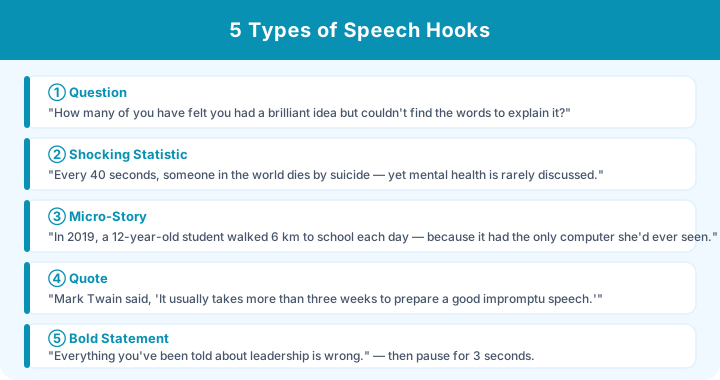
Every effective speech opening fits one of these five patterns. Choose based on your topic and audience.
- ✓Question — Ask something the audience must think about
- ✓Shocking statistic — A number that defies what the audience expects
- ✓Micro-story — A 30–60 second story with a single character and moment
- ✓Quote — Borrow authority from someone the audience already respects
- ✓Bold statement — A confident, counter-intuitive claim followed by silence
💡 Tip: Never open with 'Good morning, my name is...' — it wastes your strongest moment. Start with the hook.
📖
The Simplest Hook: A One-Sentence Story
A micro-story is the most universally effective hook because it activates imagination immediately. You only need one specific person, one moment, and one problem.
Example: "In 2019, a 12-year-old student in rural Bihar walked 6 kilometres to school every morning — not because she had to, but because the school had the only working computer she'd ever seen."
💡 Tip: Use a real name and a specific place. 'A student in Bihar' is weaker than 'Priya, from Gaya district.' Specificity creates believability.
🔗
Bridging Hook to Thesis
After your hook, use one or two sentences to connect the opening to your core message. Without this bridge, even a great hook feels like a trick. Here is a complete opening — hook, bridge, and thesis — for a speech on sleep:
Complete worked example: Hook: "In 2025, a global firm gave 500 employees access to the most advanced AI tools available. Six months later, their productivity had actually dropped."
Bridge: "That's not a technology failure — it's a habits failure. The tools were never the problem."
Thesis: "Most professionals will never use AI effectively, because they treat it as a shortcut rather than a skill — but three habits can change that starting today."
Key Takeaways
- 1The first 30 seconds set the audience's emotional contract with your speech
- 2Choose one hook type — question, stat, story, quote, or bold statement
- 3A micro-story is the easiest and most reliable hook for any audience
- 4Use a specific name and place — specificity creates believability
- 5Always bridge your hook to your thesis in 1–2 sentences
What's Next
Continue through the course in order, or jump back to review earlier lessons.