Outlining Techniques
An outline is your blueprint. Before you write a word of your speech, outlining forces you to test the logic and flow. Most structural problems are easiest to fix at this stage — not after you've written everything.
Two Outlines for Two Stages
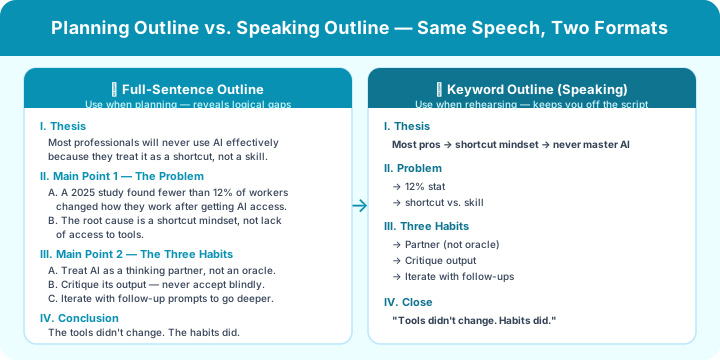
Most speakers only use one outline format. The best speakers use two — one for planning, one for delivery. The diagram below shows both applied to the same speech.
The Standard Hierarchy
Both outline types use the same three-level structure. The hierarchy keeps your main points, sub-points, and evidence visually distinct so you can spot imbalance instantly.
- ✓Roman numerals (I, II, III) — Main points — thesis, each body point, conclusion
- ✓Capital letters (A, B, C) — Sub-points — the evidence or steps supporting each main point
- ✓Arabic numerals (1, 2, 3) — Supporting detail — specific facts, quotes, statistics
Add Time Estimates
Write a target time next to every section of your outline. Discovering at the 8-minute mark that you have 15 minutes of material is one of the most common (and avoidable) speech problems.
- ✓Introduction — 10–15% of total time (1–2 min in a 10-min speech)
- ✓Each main point — ~25–33% of body time — balance them roughly equally
- ✓Conclusion — 10–15% of total time (1–2 min in a 10-min speech)
Key Takeaways
- 1Use a full-sentence outline to plan — it forces full articulation and reveals gaps
- 2Switch to a keyword outline to rehearse — prevents reading, keeps delivery natural
- 3Use Roman numerals → capital letters → Arabic numerals for hierarchy
- 4One sub-point under a main point is a structural warning sign
- 5Assign time targets to every section and rehearse with a timer
What's Next
Continue through the course in order, or jump back to review earlier lessons.