📝 Speech Structure · Lesson 8 of 9
Monroe's Motivated Sequence
Developed in the 1930s and still the gold standard for persuasive speeches. Five steps that mirror how humans naturally move from indifference to action.
🔁
The 5 Steps Applied
Each step does a specific job on the audience's psychology. The diagram maps all five steps to a speech on why most professionals will never master AI — the same topic thread from previous lessons.
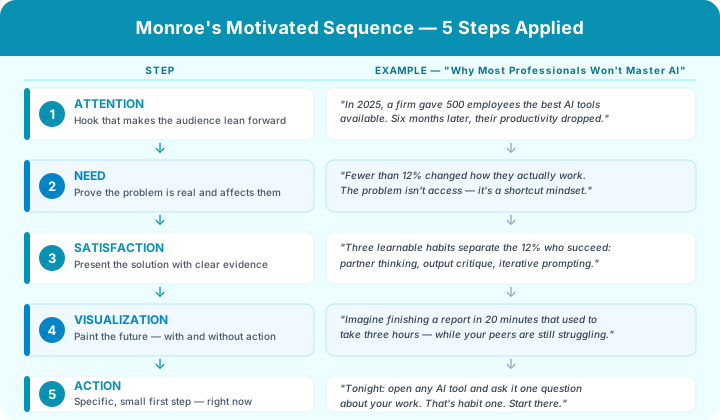
💡 Tip: The most skipped step is Visualization. Don't cut it. It's the emotional bridge between 'I understand your solution' and 'I'm actually going to do something about it.'
🎯
The Two Steps Most Speakers Get Wrong
Attention and Action are usually done reasonably well. Need and Visualization are where most persuasive speeches fail.
- ✓Need — too abstract — Saying 'this is a big problem' isn't enough. Prove it affects this specific audience in a concrete, personal way.
- ✓Need — too short — If the audience doesn't feel the problem, they won't care about the solution. Spend real time here.
- ✓Visualization — skipped entirely — Most speakers jump from solution to call to action. The visualization step is what converts understanding into motivation.
- ✓Action — too vague — 'Think about this' is not a call to action. Name the exact step, the exact time, and make it tiny.
Strong vs. weak Action step: Weak: "I hope you'll all consider using AI tools more thoughtfully."
Strong: "Tonight, before you sleep, open any AI tool and type: 'What's one part of my job you could help me do 30% faster?' That question is habit one. Start there."
📋
When to Use This Framework
Monroe's sequence is purpose-built for persuasive speeches with a clear behavioral goal. It doesn't work well for purely informative talks.
- ✓Use it for — Fundraising, volunteering, policy advocacy, sales, any speech where you want action
- ✓Don't use it for — Informative talks, technical explanations, or speeches without a call to action — use topical or problem-solution structure instead
⚠️ Watch out: Monroe's sequence only works if the audience believes the problem in step 2. If they don't accept the Need, the entire structure collapses. Front-load your evidence there.
Key Takeaways
- 1The 5 steps: Attention → Need → Satisfaction → Visualization → Action
- 2The Need step must make the audience personally feel the problem — not just understand it
- 3Visualization is the emotional engine — don't skip it
- 4End with a specific, tiny first step — not a vague encouragement
- 5Best for persuasive speeches with a clear behavioral goal
What's Next
Continue through the course in order, or jump back to review earlier lessons.