📝 Speech Structure · Lesson 4 of 9
Logical Ordering
The order of your ideas either builds understanding or creates confusion. Pick the wrong pattern and even a brilliant argument feels hard to follow.
🗺️
The 5 Patterns at a Glance
Every well-structured speech fits one of five ordering patterns. The diagram below maps each pattern to when it works best, with an example for each.
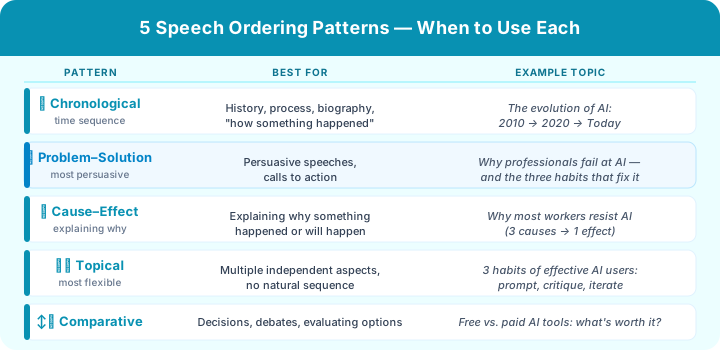
💡 Tip: When in doubt, use Problem–Solution. It's the most persuasive structure for almost any topic because it creates a felt need before offering the answer.
🔧
Problem–Solution in Practice
This is the most useful pattern for students to master. It has four steps — and each step does specific work on the audience's thinking.
- ✓Step 1: Problem — Prove it's real, significant, and affects this specific audience
- ✓Step 2: Cause (optional) — Explain why the problem exists — this stops the audience dismissing it
- ✓Step 3: Solution — Present your answer and show why it works
- ✓Step 4: Call to action — Tell the audience exactly what to do next
Applied to the example: Problem: "Most professionals now have access to AI tools — but a 2025 study found fewer than 12% changed how they actually work."
Cause: "They treat AI as a shortcut, not a skill. So they get average output from an extraordinary tool."
Solution: "Three learnable habits separate people who use AI effectively from those who don't."
Call to action: "By the end of today, pick one habit and apply it to your next task."
🧭
Choosing Your Pattern
Ask one question: what does the audience need to understand first before my argument makes sense? The answer tells you which pattern to use.
- ✓They need to know when things happened — → Chronological
- ✓They need to feel the problem before the fix — → Problem–Solution
- ✓They need to know why something happened — → Cause–Effect
- ✓The aspects are independent — no natural sequence — → Topical
- ✓They need to weigh options and decide — → Comparative
⚠️ Watch out: Never bury your strongest point in the middle. Put it first (primacy) or last (recency) — audiences remember the beginning and end far better than the middle.
Key Takeaways
- 1The 5 patterns: Chronological, Problem–Solution, Cause–Effect, Topical, Comparative
- 2Problem–Solution is the most persuasive — it creates a felt need before the answer
- 3The right pattern makes your logic feel obvious, not forced
- 4Choose your pattern by asking: what must the audience understand first?
- 5Put your strongest point first or last — never in the middle
What's Next
Continue through the course in order, or jump back to review earlier lessons.