Transitions & Signposting
If an audience looks confused or disengaged mid-speech, it's almost never a content problem — it's a signposting failure. These four tools keep every listener oriented at every moment.
The 4 Signposting Tools
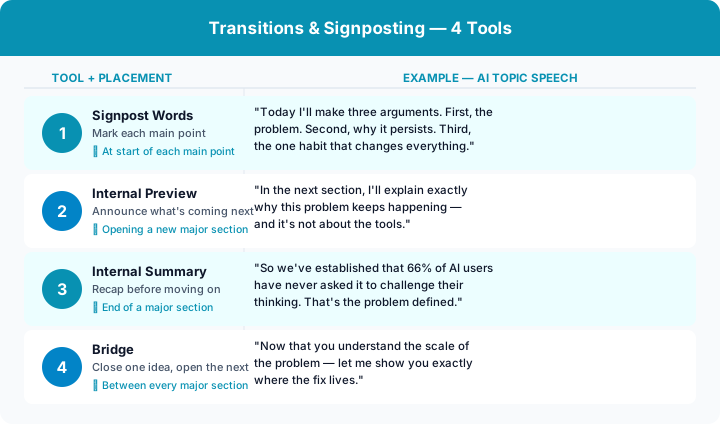
Signposting is the spoken equivalent of section headings, paragraph breaks, and bold text. Without it, even a perfectly structured speech can feel like a wall of words. The diagram maps each tool to its position in a speech and shows a live example from the sample speech.
A Worked Example — 4 Tools in Sequence
This is a 2-minute segment from the middle of the sample speech. All four tools appear in order: signpost word opens the section, internal preview sets up what's next, internal summary closes the section, bridge connects to the next.
The Placement Rule
Each tool has a specific moment where it belongs. Using the wrong tool at the wrong moment is almost as disorienting as using none at all.
- ✓Signpost words — At the start of each main point — "First…", "Second…", "Finally…", "Let's turn to…"
- ✓Internal preview — At the opening of a new major section — tell them what they're about to hear before they hear it
- ✓Internal summary — At the close of a major section — recap in one or two sentences before moving on
- ✓Bridge — At every boundary between major sections — one sentence that closes the previous idea and opens the next
Key Takeaways
- 1Signpost words mark each main point — First, Second, Finally, Let's turn to
- 2Internal previews announce what's coming before a new section begins
- 3Internal summaries recap before moving on — don't skip them in speeches over 5 minutes
- 4A bridge closes one idea and opens the next in a single sentence
- 5If an audience looks lost, it's almost always a signposting failure, not a content failure
What's Next
Continue through the course in order, or jump back to review earlier lessons.